


5 Portuguese Castles You Must Visit
5 Portuguese Castles You Must Visit
Portugal’s landscape is defined by its remarkable military architecture, a lasting legacy of centuries of conquest, conflict, and resilience. From the fierce campaigns of the Reconquista to the defence of Portuguese independence against Castile and, centuries later, the invasion of Napoleon’s armies, the country’s castles, fortresses, and fortified towns stand as enduring symbols of a nation shaped by struggle. Today, these impressive monuments offer far more than a window into Portugal’s military past. They reveal the evolution of medieval architecture, the daily lives of those who lived within their walls, and the changing strategies used to defend communities and territories over the centuries.
Visiting a castle is one of the most rewarding ways to step back in time. Wandering through ancient ramparts, towers, and courtyards brings Portugal’s history vividly to life while showcasing the architectural ingenuity of each era. In this article, we explore five of the most beautiful castles in Portugal, each offering a unique perspective on the country’s rich cultural and historical heritage.
Castelo de São Jorge, Lisbon
Perched atop the highest hill in Lisbon, Castelo de São Jorge is one of the city’s most iconic landmarks. Originally built as a Moorish fortress in the 9th century, it was captured by Portugal’s first king, Afonso I, in 1147, and later served as a royal residence.
With its imposing towers, ancient walls, and sweeping views, the castle invites visitors to step back in time and discover the rich tapestry of Portugal’s history. Its architecture reflects the many cultures and civilizations that have shaped Lisbon over the centuries, blending Moorish influences with medieval Portuguese traditions.
Dominating the Alfama skyline, Castelo de São Jorge seems to anchor Lisbon’s historic hills and offers one of the city’s most spectacular panoramas. The castle has endured centuries of political and cultural change, as well as the devastating earthquake of 1755.
Visiting Castelo de São Jorge is about more than exploring a historic monument. It is an opportunity to experience the very essence of Lisbon — a city shaped by conquest, discovery, resilience, and renewal
Castelo dos Mouros, Sintra
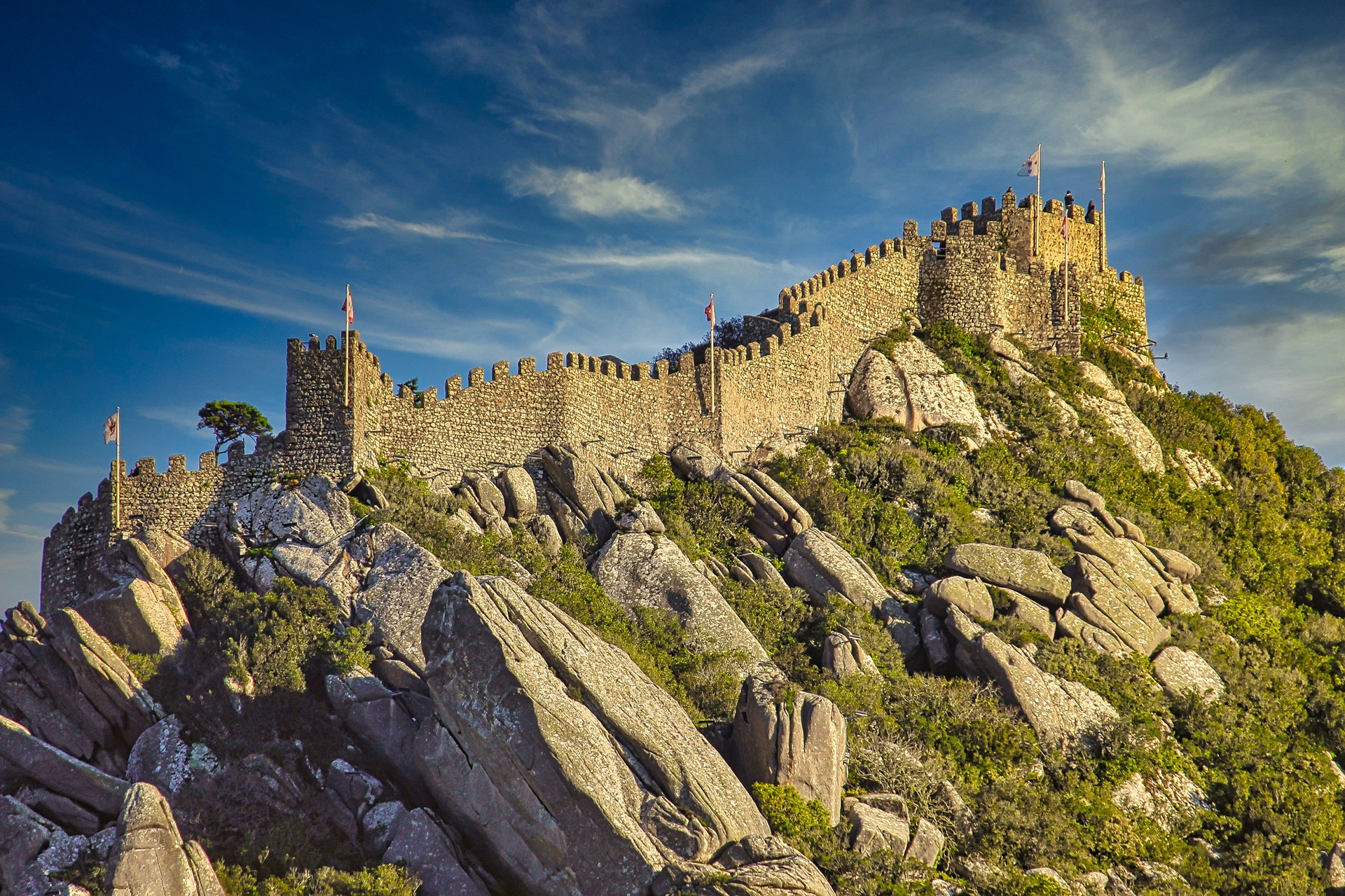
Winding over two ridges of the Serra de Sintra, this Moorish Castle dates back to the early days of the Moorish occupation of the Peninsula – the 8th Century.
It has been classified as a UNESCO World Heritage Site and is one of the most famous landmarks in Portugal.
After various attempts it was definitively taken by Dom Afonso Henriques in 1147, and there was built the first Christian Chapel of the borough.
In the romantic period, about 1860, the walls were restored under the supervision of Dom Fernando II, husband of Dona Maria II, obsessed with art, theatre, bohemia, and the Middle Ages, sought to transform the entire town of Sintra by ordering the castle’s renovation.
Castelo de Almourol, Santarém
In the middle of the River Tagus, the enigmatic Castelo de Almourol is one of the most emblematic monuments of the Christian reconquest. Located on a small island in the Tagus River, this Templar fortress is accessible by boat and offers panoramic views of the river and countryside
Its history reminds us of the Reconquest of the Portuguese territory during the Middle Ages. When the Christians arrived here in 1129, the castle already existed under the name of Almorolan, having been incorporated immediately afterwards into the land that was placed under the protection of the Knights Templar, whose Master at that time was Gualdim Pais. According to an inscription at the entrance to the castle, its reconstruction work began in 1171.
After the Order of the Knights Templar was disbanded and the need to defend the territory no longer existed, the castle lay abandoned and forgotten until it was espoused by the prevailing Romantic spirit of the 19th century and restored to its present-day appearance.
Castelo de Guimarães, Guimarães
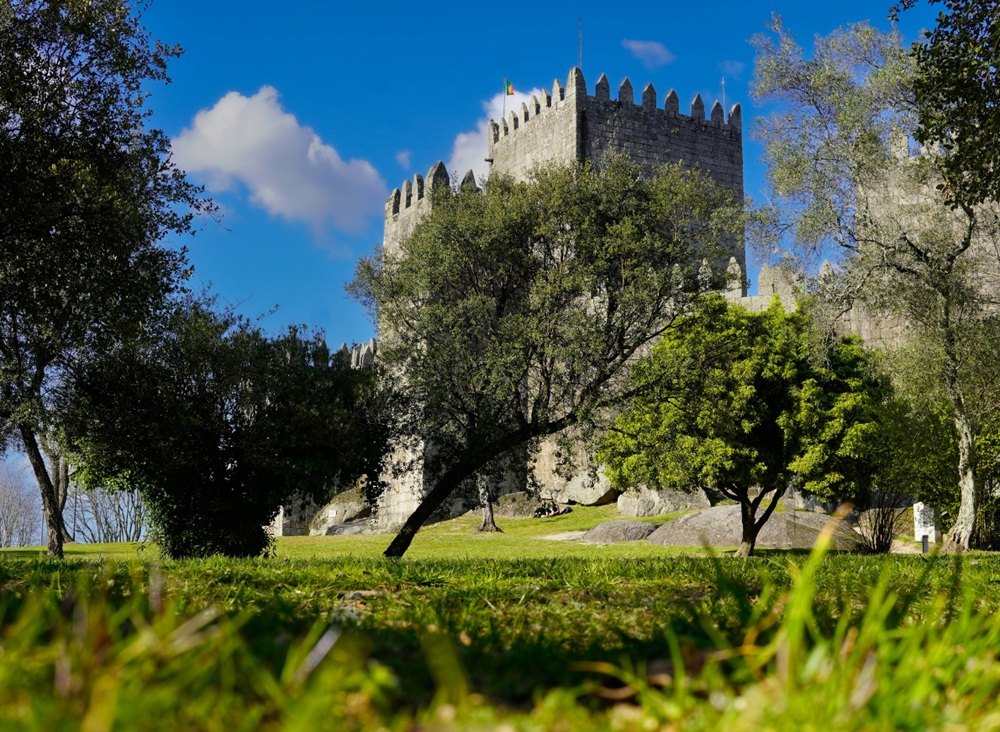
Located in northern Portugal, in the historic city of Guimarães, the castle evokes the fascinating blend of legend, poetry, and heroism that surrounds the origins of Portuguese history. It was on this hill, known as Monte Largo (Broad Hill) and referred to as Alpis Latitus in Latin documents of the time, that the foundations of the future Portuguese nation began to take shape.
The castle was built in 968 on the orders of Mumadona Dias, Countess of Galicia, to provide the local population with a place of refuge from Viking attacks. It also served to protect the surrounding region and the nearby monastery from enemy invasions.
Today, the castle’s imposing ramparts and towers, together with the surrounding historic centre of Guimarães, form part of a UNESCO World Heritage Site.
Castelo de Tomar, Tomar
In 1983, UNESCO inscribed the Templar Castle and the Convent of the Knights of Christ in Tomar on the World Heritage List, recognizing this unique monument as an exceptional testimony to the history of the Western world.
Located in Tomar, the imposing Castle and Convent of Christ are a must-see for anyone with an interest in history, heritage, architecture, and the extraordinary story of Portugal.
Portugal’s first king, Afonso Henriques, granted the Knights Templar vast territories between the Mondego and Tagus rivers. According to legend, when the Knights reached the region, they were encouraged by favourable omens to choose a hill on which to build their castle and to give the settlement the name Tomar.
The Order of the Temple was officially dissolved in 1314 following its persecution by King Philip IV of France, known as Philip the Fair. However, at the initiative of the Portuguese king, D. Dinis, the members of the Order, together with their property and privileges, were incorporated into a new military order in 1319: the Order of Christ. In Portugal, the Templars were therefore able to continue their religious and military mission under a new name.
Together with Prince Henry the Navigator, the Order of Christ played a significant role in preparing Portugal for the great maritime expeditions of the fifteenth and sixteenth centuries.
Under his leadership, the knights’ mission increasingly became linked to Portugal’s maritime expansion. This was why the caravels bore the Cross of the Knights of Christ on their sails, and this sign was to be carved into various stone landmarks all around the world.
We hope this article has sparked your curiosity about Portugal’s rich history and heritage. There is so much more to discover! Get in touch with our team to learn more about Portugal and explore everything this fascinating country has to offer.